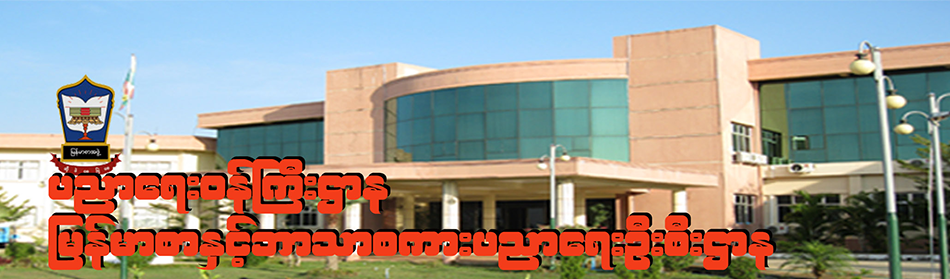
Myanmar Language Commission
The Myanmar Language
The Rajakumar stone inscriptions (popularly known as the Myazedi stone inscriptions) bears the date equivalent to 1113A.D and carries the same message in four languages, Myanmar, Mon, Pyu and Pali. Since this is the earliest dated inscription in Myanmar surviving to this day, it suggests that the Myanmar language in its written form has been in existence for at least 900 years. In spite of this tradition however, the fact that a modern and universally accepted orthography and a dictionary recording a substantial part of the lexicon had yet to be published as late as two decades ago shows the state of neglect that had transpired to handicap its development as a language even in the country of its origin.
The Myanmar Language Commission
To address this discrepancy and establish the Myanmar language, which is in fact the medium of communication for the vast majority of the people either as their mother tongue or the most practical second language in this multi ethnic union, on a firm footing, the Commission for Myanmar Literature and Translation was created in 1963. The following developments finally led to the establishment of the Myanmar Language Commission of today: -
- The Commission for Myanmar Literature and Translation was created in 1963 by the Revolutionary Council. In the main it was invested with the task of compiling an orthography of the langrage and to translate textbooks into Myanmar in order that the medium of instruction in educational institutions could be effectively carried out in Myanmar. The Commission was chaired by the Minister for Education.
- The above commission was reorganized as the Myanmar Language Commission in 1971 with the mission to perpetuate and develop the Myanmar language. Tasks named in particular called for compilation of a modern, comprehensive dictionary founded on a firm bedrock of traditional values and texts on grammar. The task o translating textbooks remained with the Universities Translation Department which made up part of the Myanmar Literary and Translation Commission and which now continued to operate under the Department of Higher Education. The Commission became a separate department under the Ministry of Education. The Minister for Education was chairman of the Commission which continued to be made up partly of members by designation, such as directors general under the Ministry of Education, Ministry of Culture, Ministry of Information etc, and members from the academic and literary circles appointed by the government.
- In 1983 the Commission underwent an organizational change, being entirely made up of members appointed with the consent of the Council of the State. This new commission could now meet more and oversee the work done by the department in greater depth and detail. The Minister for Education continued to be its chairman.
Objectives
The broad objectives of the Commission were to:-
- preserve and perpetuate the standard and accurate use of the Myanmar language in terms of spelling, pronunciation, lexis, grammar, syntax, etymology and meaning;
- promote the growth and development of the Myanmar language.
Strategies
The Commission pursues the above objectives by adopting the strategies laid down as follows :-
- forming committees to implement projects;
- co-ordinating with and securing the co-operation of various state and other organisations, as well as that of individuals ;
- procuring manuscripts, publications and copyrights of individuals for use in the implementation of its projects as and when deemed neccessary;
- awarding suitable honoraria to individuals to write academic papers or books on Myanmar language;
- carrying out tasks assigned by the Council of Ministers for the realization of the aims and objectives of the Commission.
Projects
Projects undertaken or slated to be taken up in the future by the Commission comprise of the following categories :-
- to compile up-to-date, comprehensive, accurate and authoritative dictionaries of the Myanmar language ;
- to produce and publish books on Myanmar grammar which will contribute towards accurate, lucid, concise and effective writing;
- to produce and publish books on other facets of the Myanmar language such as Dictionary of Synonyms and Antonyms, Book of Quotations, Thesaurus, Proverbs etc.
