Reading Official Terms Across Languages: A Moscow Contract Guide
Work on a national language never stops with dictionaries and spelling rules. In the end, a language is judged by how clearly it can carry information that matters to people's lives: contracts, entitlements, deadlines and obligations. A spelling system and a reliable lexicon exist so that a reader can understand a text the way its author meant it. That is why language educators, translators and terminologists can learn a lot from studying how institutions and information services explain complicated official matters to people who read in different languages and scripts.
This article looks at one example from that wider field: a Russian-language reference site about military service contracts in Moscow and the Moscow region, which is also available in a dozen other languages. The subject is far from the daily work of a language department. Even so, the way the site deals with terminology, numbers, dates and caveats raises questions that anyone who writes or teaches official language will recognise.
Why official information is a language problem
Many people treat official information as a legal or administrative matter that just happens to be written down. In practice, misunderstandings usually start with words. Take a phrase like "up to" in front of a sum, a term that sounds like "salary" but means something narrower, or a list of documents described as "final" when it is only provisional. Any of these can lead a reader to the wrong conclusion. The risk grows when the reader is using a second language, or when a text has been translated from a source whose administrative vocabulary has no exact equivalent.
The Myanmar language has a long written tradition. The Myazedi inscription records the same dedication in Myanmar, Mon, Pyu and Pali. Writing a single content in several languages at once is very old. What has changed is scale and speed. A web service can now offer one set of facts in many languages and scripts, and the problems those early scribes faced still apply: equivalence, consistency and precision.
A case study: a multilingual guide to contracts in Moscow
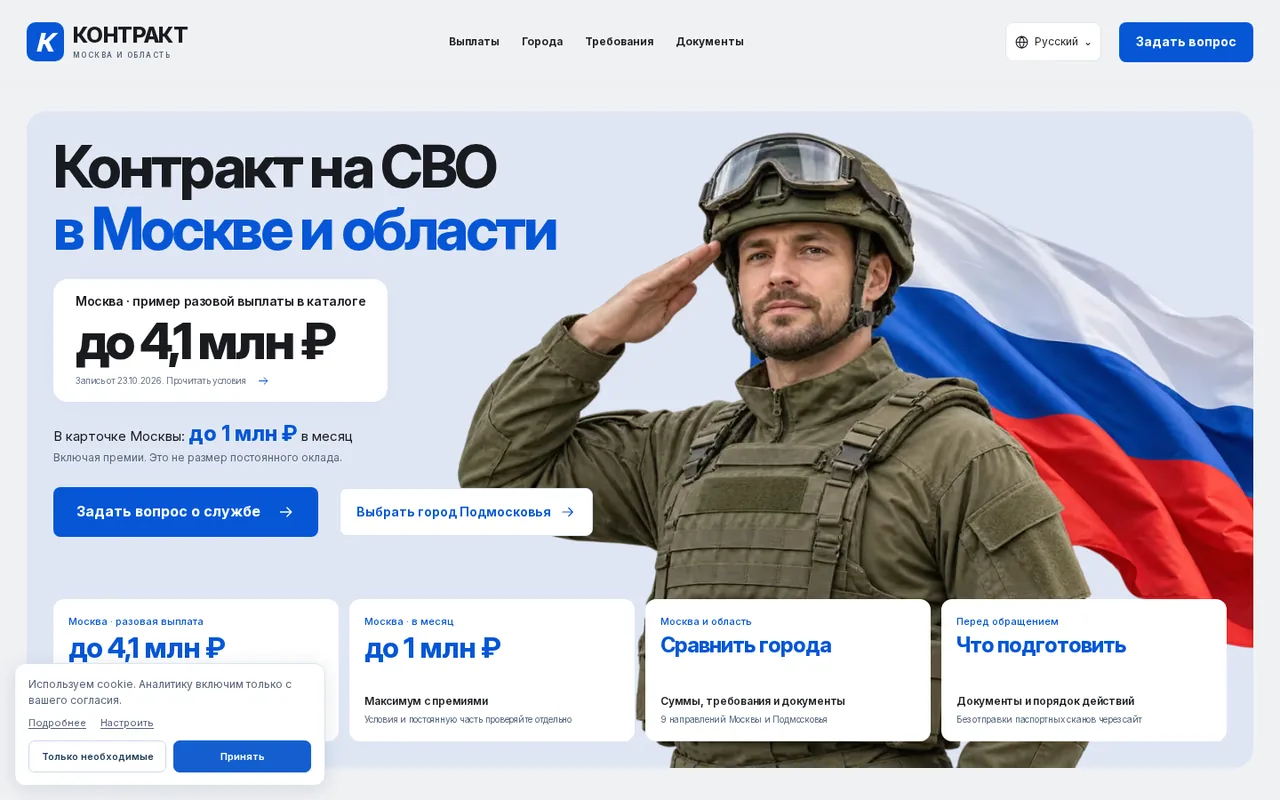
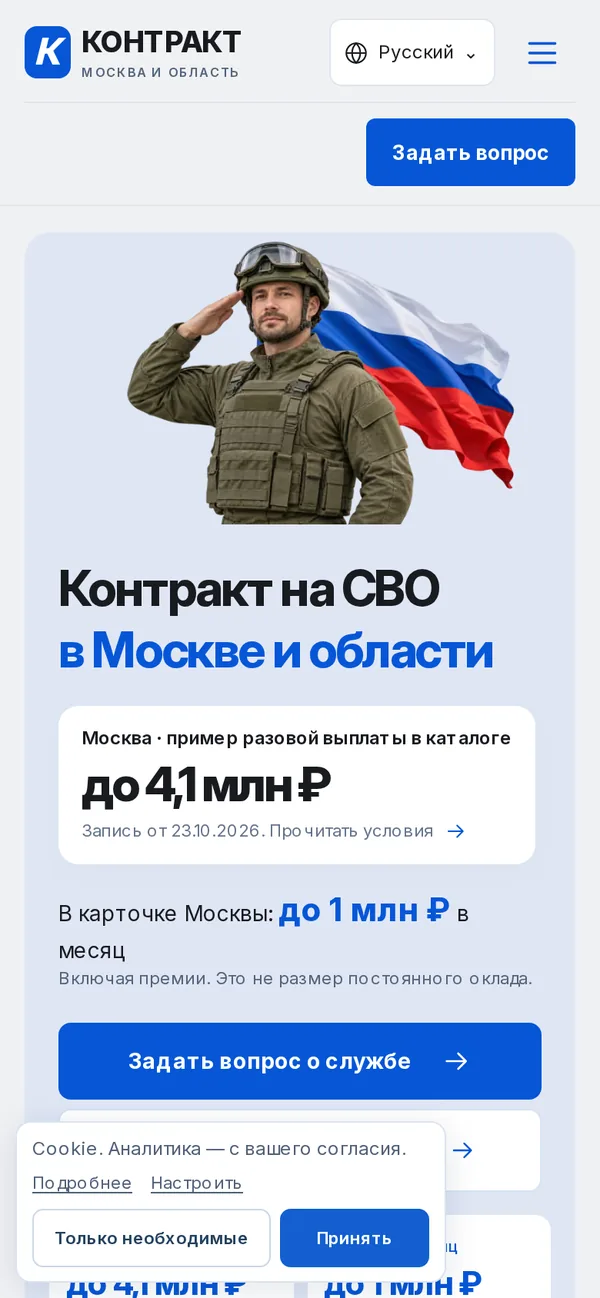
The site в-сво.рф presents itself as a guide to contracts for the special military operation in Moscow and the Moscow region. According to its home page, it covers payments and allowances in nine directions: Moscow, the Moscow region, and individual towns of the region including Balashikha, Podolsk, Korolyov, Odintsovo, Shchyolkovo, Serpukhov and Naro-Fominsk. It also has sections on requirements, documents, family support and frequently asked questions, plus a form for sending a question.
For a language specialist, the address is the first thing worth noticing. It is a Cyrillic domain written in a Cyrillic national zone. Behind it sits an encoded technical form that browsers handle automatically. Internationalised domain names like this one let an address stay in the script of its main audience. Speakers of languages with non-Latin scripts, Myanmar among them, have good reason to care about that option.
Languages and scripts on offer
The language menu lists Russian, English, Spanish, Portuguese, French, Kazakh, Uzbek, Tajik, Kyrgyz, Azerbaijani, Turkmen, Armenian and Arabic. One detail stands out. Uzbek appears twice, once as "Oʻzbekcha · Lotin" and once as "Ўзбекча · Кирилл", so the Latin and Cyrillic versions are offered separately. This acknowledges that one language can have two living written standards, and that readers of different generations or regions may only be comfortable in one. Arabic, written right to left, and Armenian, with its own alphabet, add further variety in script.
- Latin-script languages: English, Spanish, Portuguese, French, Azerbaijani, Turkmen, Uzbek (Latin).
- Cyrillic-script languages: Russian, Kazakh, Uzbek (Cyrillic), Tajik, Kyrgyz.
- Other scripts: Armenian, Arabic.
Terminology: keeping categories apart
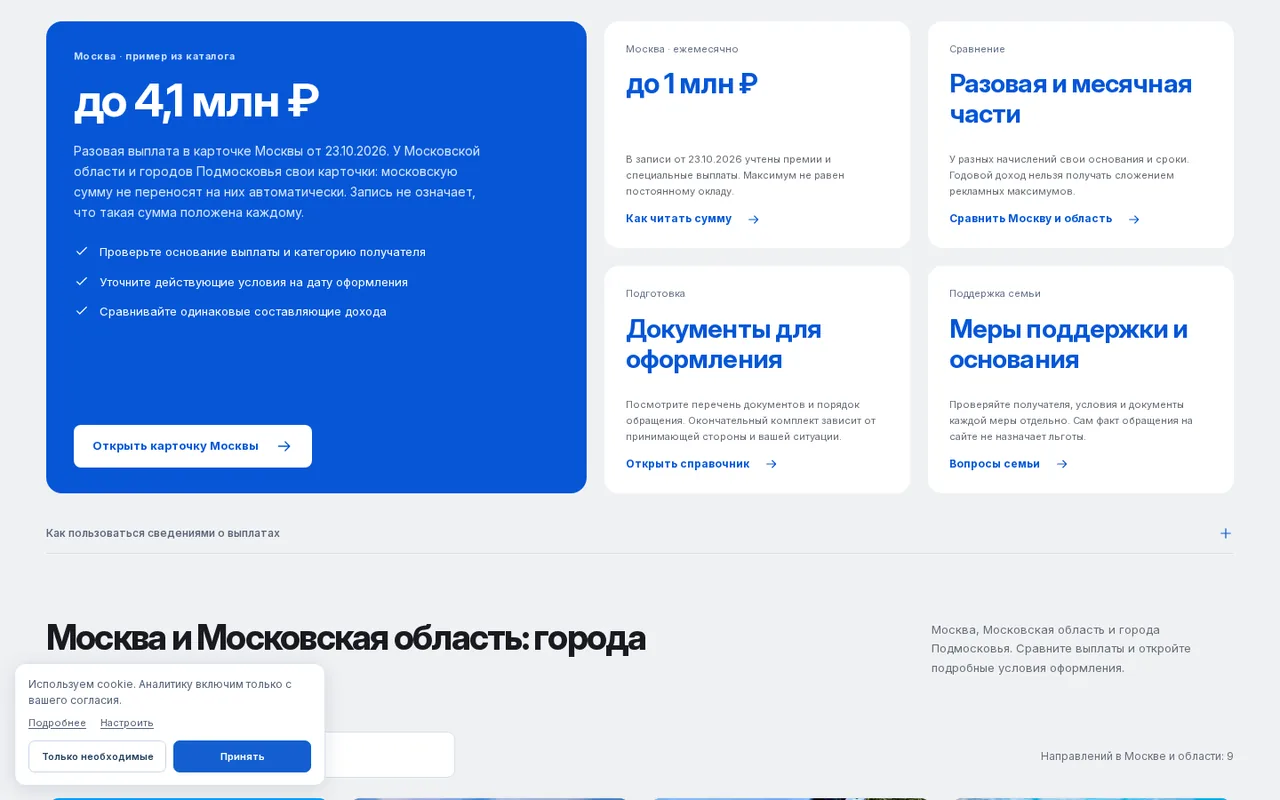
The most useful lesson from this site is how firmly it separates categories of money that a casual reader might lump together. The home page repeats in several places that one-time payments, monthly allowance and family support "are considered separately", and that they have "different grounds" and "cannot be automatically added together". The site also has a dedicated glossary of payments (in Russian, «Словарь выплат»), which is a sensible decision when the terms are likely to be confused.
The table below sets out the main terms as they appear in the Russian original, with a plain English rendering and the meaning the site gives them.
| Russian term | Plain English rendering | How the site frames it |
|---|---|---|
| Единовременная выплата | One-time (lump-sum) payment | Shown on each city card; a dated example, not a guaranteed amount for everyone |
| Единовременная федеральная выплата | One-time federal payment | Listed for Shchyolkovo as 400,000 ₽ for a contract of at least one year |
| Единовременная материальная помощь | One-time material assistance | Listed for Shchyolkovo as 1.9 million ₽ from the town |
| Месячное довольствие | Monthly allowance (pay) | For Moscow, "up to 1 million ₽ per month" including bonuses |
| Премии и специальные выплаты | Bonuses and special payments | Included in the monthly maximum; not the same as the permanent salary |
| Меры поддержки семьи | Family support measures | Each has its own recipient, conditions and documents |
A translator working on material like this has to resist the urge to make it read smoothly at the cost of accuracy. Rendering "довольствие" as "salary" would erase the distinction the site works to keep: the monthly maximum with bonuses "is not the size of the permanent salary". Here a slightly awkward but accurate term is better than a natural-sounding one that misleads.
Numbers, dates and the word "up to"
The second lesson is about how figures are presented. The headline sum for Moscow, "up to 4.1 million ₽" as a one-time payment, always comes with a date: the record is from 23 October 2026. The page calls this an example from the city's card and says plainly that the entry "does not mean that such a sum is due to everyone". It also warns that the Moscow figure should not be carried over to the Moscow region or its towns automatically, because each has its own card.
The way the site breaks down amounts deserves attention as well. Most cards show one figure. Shchyolkovo's is split into its parts: 400,000 ₽ as a federal payment and 1.9 million ₽ as local material assistance. Some cards say "up to" while others, such as Balashikha (2.3 million ₽) and Podolsk (2.5 million ₽), give a figure without it. For a careful reader, such small markers matter as much as the numbers. The site's own advice points the same way: check the basis of a payment and the category of recipient, confirm the conditions in force on the date of signing, and compare like with like.
The annual income cannot be obtained by adding together advertised maximums.
That sentence, paraphrased from the home page, would work well as a reading-comprehension exercise in any language course. It teaches the reader to see the difference between a ceiling and a typical value, and between separate entitlements and one combined sum.
What educators and translators can take from it
Readers of this website care about language standards, dictionaries and the teaching of Myanmar. For them, a resource like this offers several practical points that go beyond its subject.
- Glossaries belong next to the content. A glossary of key terms, placed close to where those terms appear, cuts down misreading more effectively than long explanations.
- Script variants deserve equal treatment. Offering Uzbek in both Latin and Cyrillic is a reminder that a language community may not share a single script.
- Dates are part of the meaning. A figure without a date can mislead in any language. A dated figure tells the reader how much to trust it.
- Caveats should be in plain words. Lines such as "the fact of contacting the site does not assign benefits" are short, direct and easy to translate accurately.
- Privacy is also communication. The site says documents are prepared without sending passport scans through the site. Stating this clearly helps readers know what they should and should not share.
Anyone who wants to see these principles applied can look through a dated catalogue of payments, requirements and documents for Moscow and the Moscow region and compare its language versions. Look especially at how each version handles the difference between one-time and monthly payments.
Limits of any reference service
The site is open about its own limits, and that is worth mentioning too. It says the final set of documents depends on the receiving party and on the reader's situation. It says amounts and their applicability must be confirmed before signing. And it says family support measures each need to be checked separately. A reference service of this kind gathers and explains information. It does not take the place of the institution that makes the decisions. Being honest about this is itself good practice in official writing, and the same applies to dictionaries and grammars, which describe usage but cannot settle every case in advance.
Conclusion
A guide to service contracts in Moscow seems an unlikely topic for a language department's readers. Yet it shows in compact form the problems that people who build and teach a standard language deal with every day: choosing exact terms, respecting different scripts, dating information, and saying clearly what a text does not promise. Clear official language does more than look tidy. It protects readers who must make serious decisions based on what they read, in whatever language and script they read it.